"What if losing the ability to move or speak didn't mean losing the ability to communicate?"
For decades, one of the most difficult challenges in neurology has been helping people whose brains remain capable of generating thoughts but whose bodies can no longer reliably express them.
Patients living with paralysis, amyotrophic lateral sclerosis (ALS), severe stroke, and other neurological conditions may retain the ability to think, understand, and communicate internally while losing control of the muscles required to speak, move, or interact with technology.
Now, a rapidly advancing field is beginning to change that equation.
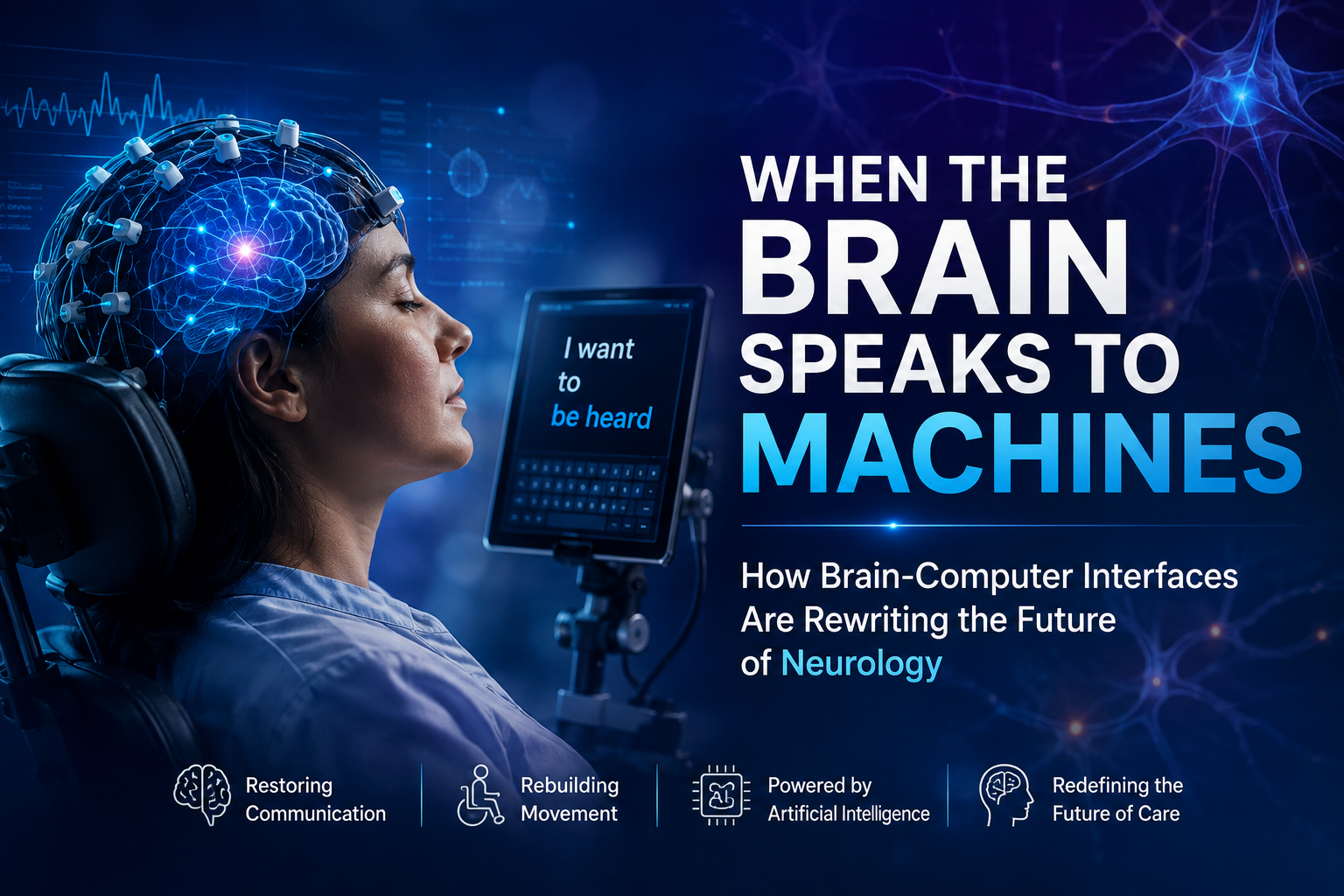
Brain-computer interfaces (BCIs) are creating a direct communication pathway between the brain and external technology-allowing neural signals to control computers, robotic systems, and communication devices.
What once sounded like science fiction is increasingly becoming a clinical research reality.
From Thought to Action
A brain-computer interface works by detecting patterns of electrical or physiological activity associated with a person's intended movement or communication.
The system then translates those signals into commands.
A person may imagine moving a hand.
The brain produces a recognizable neural pattern.
Sensors capture that activity.
Artificial intelligence interprets the signal.
The computer converts it into an action.
That action could be moving a cursor, selecting a letter, controlling a robotic device, or generating speech.
The remarkable part is that the person does not necessarily need to physically move the body part they are imagining.
The brain signal itself becomes the command.
A Major Step Beyond the Laboratory
BCIs have existed as a research concept for years, but 2026 has brought increasing attention to their potential for practical neurological care.
In July 2026, researchers reported that a man unable to speak because of paralysis successfully used a brain-computer interface system at home to communicate. NIH described the development as a potential practical communication tool for people who cannot speak because of problems affecting their muscles.
This is significant for one reason:
The technology is beginning to move outside controlled laboratory environments.
Real-world use introduces challenges that laboratory demonstrations cannot fully capture-daily routines, changing environments, device reliability, caregiver support, long-term usability, and patient independence.
A successful home-based application therefore represents more than a technological demonstration.
It is a step toward clinical translation.
How Does a Brain-Computer Interface Actually Work?
At its core, a BCI creates a communication bridge between neural activity and an external device.
Depending on the technology, brain signals may be collected using implanted electrodes or non-invasive sensors.
The system then processes those signals and uses computational algorithms to identify patterns associated with specific intentions.
For example:
Brain activity → Signal acquisition → Signal processing → AI interpretation → Intended command → Device response
The more accurately the system can distinguish between different neural patterns, the more naturally a person can interact with the technology.
Artificial intelligence is becoming particularly important in this process.
Modern machine-learning systems can help decode complex neural signals and continuously improve how those signals are translated into meaningful actions.
Giving a Voice Back to People Who Cannot Speak
One of the most promising applications of BCIs is communication.
For individuals with severe paralysis, conventional communication methods may require eye movement, hand movement, or other residual motor abilities.
A neural communication system could potentially bypass some of these physical limitations.
Instead of typing with a finger, a person could select letters through decoded brain activity.
Instead of physically producing speech, neural signals associated with intended speech could potentially be converted into synthesized language.
Recent research has demonstrated increasingly sophisticated speech and cursor-control capabilities, including long-term independent use of an intracortical BCI.
The ultimate goal is not simply to make a computer respond to thoughts.
It is to restore human independence.
The ability to say:
"I need help."
"I want to talk to my family."
"I'm comfortable."
"I want to go outside."
For someone who has lost conventional communication, those simple sentences can represent an extraordinary return of autonomy.
Beyond Communication: Could BCIs Help Rebuild Movement?
Communication is only one part of the story.
Researchers are also exploring BCIs for neurological rehabilitation.
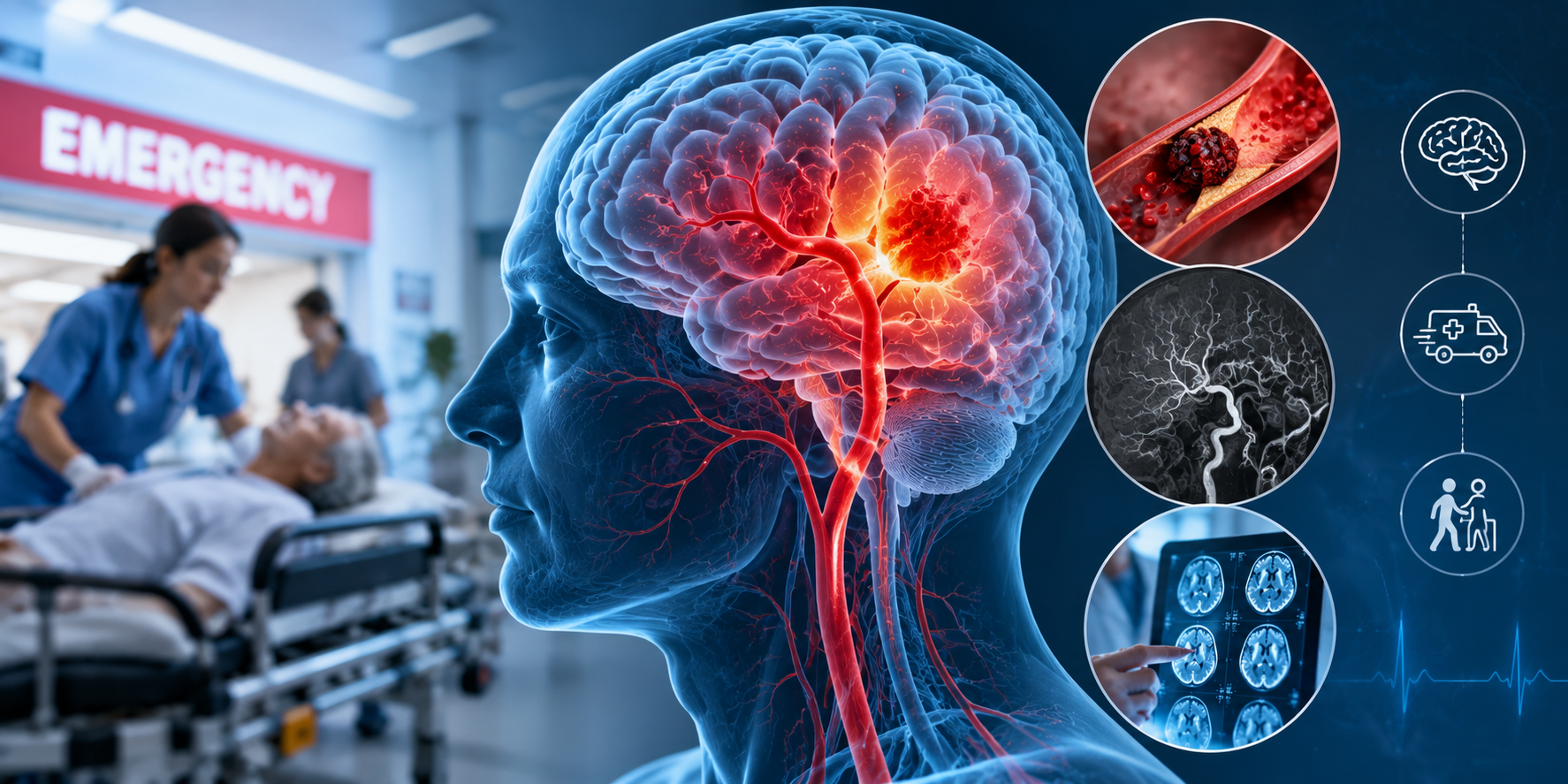
Stroke is one important area of investigation.
After a stroke, damage to specific brain regions can impair movement, speech, coordination, memory, or other functions. Rehabilitation attempts to help the nervous system reorganize and recover function.
BCIs may add another layer to this process by creating a closed feedback loop between brain activity and physical rehabilitation.
For example, when a patient attempts to move an affected limb, the BCI can detect the corresponding neural activity and provide real-time feedback.
The system may then assist with the intended movement.
This creates an interaction between:
Intention → Neural signal → Technology → Movement → Feedback
The repeated loop may help reinforce neural pathways involved in motor recovery.
A 2026 review of closed-loop BCI technology highlighted its potential role in post-stroke rehabilitation, while a systematic review and meta-analysis found that BCI-based training was associated with improvements in global cognitive function, attention, executive function, and activities of daily living in stroke survivors.
However, researchers continue to study how these technologies should be optimized and which patients are most likely to benefit.
The Rise of AI-Powered Neurology
The development of BCIs is part of a much larger transformation taking place across neurology.
Artificial intelligence is increasingly being used in neuroimaging, neurophysiology, genetics, clinical decision support, and other areas of neurological care.
A 2026 Nature Reviews Neurology perspective described AI in neurology as reaching an important inflection point, while emphasizing that translating algorithms from research environments into meaningful clinical benefits remains a major challenge.
BCIs represent an especially interesting intersection between neuroscience and artificial intelligence.
The brain produces incredibly complex signals.
AI provides the computational tools required to identify patterns within those signals.
Together, they create a new possibility:
technology that does not simply respond to physical movement, but interprets neurological intention.
What Could the Future Look Like?
Imagine a person with severe paralysis sitting in a wheelchair.
They cannot move their hands.
They cannot speak.
But they want to communicate.
Instead of relying entirely on conventional input devices, a BCI could potentially detect their intended words and translate them into synthesized speech.
Now imagine another patient recovering from stroke.
The patient attempts to move an impaired hand.
The BCI detects the motor intention and provides immediate feedback through a rehabilitation device.
Over repeated sessions, the system could become part of a personalized rehabilitation program.
These scenarios are still evolving.
But they illustrate why BCIs are attracting so much attention across neuroscience, rehabilitation medicine, engineering, and artificial intelligence.
The Challenges Are Just as Important
The excitement surrounding BCIs should not overshadow the difficult questions that remain.
1. Long-Term Reliability
Neural signals can change over time. Systems must remain accurate and useful during extended periods of real-world use.
2. Patient Safety
Implanted BCIs require surgical procedures, making safety, infection risk, device longevity, and clinical monitoring important considerations.
3. Accessibility
Advanced neurological technologies can be expensive and technically demanding.
If they remain available only at highly specialized centers, their impact will be limited.
4. Privacy
A technology capable of interpreting neural activity introduces an entirely new category of personal data.
Questions surrounding neural data privacy and security will become increasingly important as BCIs develop.
5. Clinical Validation
A promising laboratory result does not automatically become a standard treatment.
Researchers still need robust clinical trials, long-term follow-up, standardized protocols, and evidence demonstrating meaningful benefits for patients.
A New Definition of Neurological Rehabilitation
Traditional rehabilitation often focuses on training the body to recover function.
BCIs introduce another possibility:
training the connection between intention, brain activity, technology, and movement.
This could eventually contribute to more personalized rehabilitation strategies in which technology adapts to the patient's neurological signals rather than providing exactly the same intervention to every individual.
That is an important shift.
Neurology is increasingly moving toward precision, personalization, and real-time neurological monitoring.
BCIs could become one of the technologies helping drive that transformation.
Where Neurology Goes Next
The future of neurology may not be defined by a single breakthrough.
It may be defined by the convergence of several technologies.
Artificial intelligence can interpret complex neurological data.
Wearable devices can continuously monitor physiological signals.
Advanced imaging can reveal structural and functional changes in the brain.
Neuromodulation can influence neural activity.
And brain-computer interfaces can create a direct bridge between the brain and technology.
Together, these developments are changing an old assumption:
That neurological disability must always mean a permanent loss of independence.
BCIs do not eliminate neurological disease.
They do not restore every lost function.
And they are not yet a universal solution.
But they are opening a new scientific possibility—one in which the brain itself becomes part of the interface through which patients communicate, rehabilitate, and interact with the world.
The Bigger Picture
The most exciting part of brain-computer interface research may not be the technology itself.
It is what the technology represents.
For someone who has lost the ability to speak, communication is freedom.
For someone recovering from stroke, movement is independence.
For someone living with severe paralysis, controlling a device can restore a sense of agency.
Neurology has traditionally focused on understanding what goes wrong inside the nervous system.
The next chapter may increasingly focus on something equally important:
How can we build technologies that work with the nervous system to restore what neurological disease has taken away?
The answer may begin with a signal from the brain.
And that signal could change everything.
Key Takeaways
Brain-computer interfaces are emerging as an important frontier in modern neurology.
BCIs can translate neural activity into commands for computers and communication systems.
Recent research is moving BCI technology from laboratory demonstrations toward real-world and home-based applications.
Stroke rehabilitation is another promising area, particularly through closed-loop systems that connect brain activity with real-time feedback.
Artificial intelligence is becoming increasingly important in decoding complex neurological signals.
Major challenges remain, including safety, reliability, accessibility, privacy, and long-term clinical validation.
BCIs could ultimately become part of a broader shift toward personalized and technology-enabled neurological care.
About Medex Conferences
MedEx Conferences is committed to sharing evidence-based medical insights, emerging clinical research, and global scientific developments that connect healthcare professionals, researchers, academicians, clinicians, and innovators across the neurological sciences.
References
Nature Medicine – Long-term independent use of an intracortical brain-computer interface
Journal of Neurology – Brain-computer interface training in stroke patients
Frontiers in Neurology – Closed-loop brain-computer interfaces for stroke rehabilitation